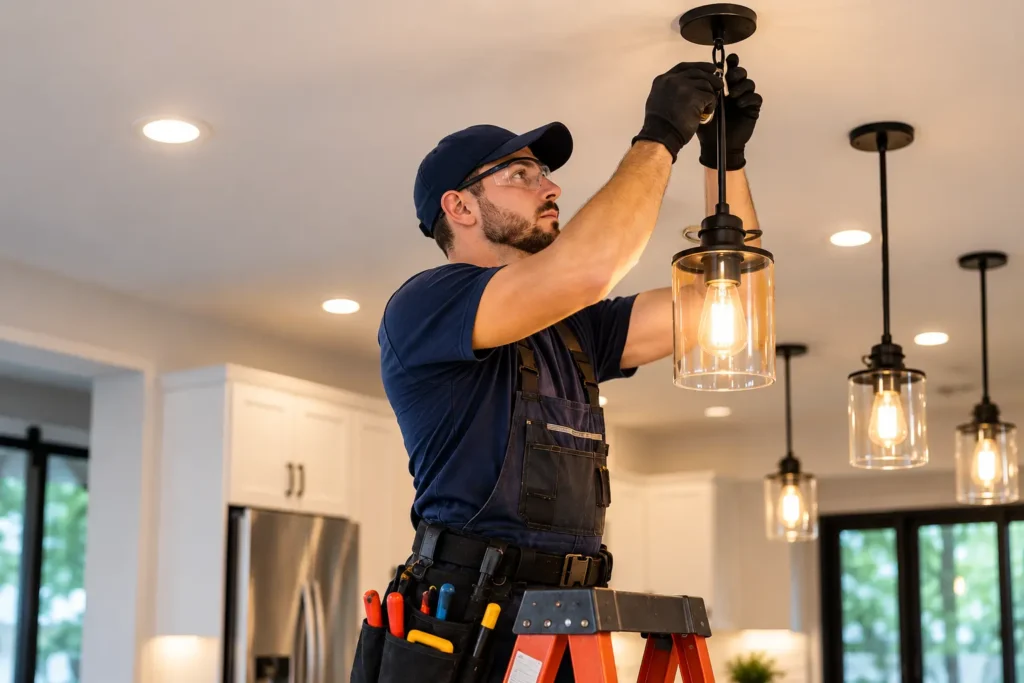
Looking for lighting installation Monroe GA homeowners can rely on? Lighting upgrades cover everything from swapping a tired fixture to laying out a full recessed plan for a room.
Next Gen Electric Co. installs recessed cans, LED retrofits, under-cabinet, exterior and landscape lighting across Monroe - planned around how you actually use the room, then wired, switched and dimmed properly rather than tapped into whatever was already there.
Recessed lighting runs $125 to $300 per light installed nationally, with $180 the most common figure. Six cans in a kitchen typically lands between $700 and $1,650.
Attic access is the biggest cost driver. Wiring around joists and ducts in a finished ceiling can add roughly $200 per light.
Colour temperature is the most common regret — the layout was fine, the light feels wrong. Keep it consistent within sight lines.
If you already have working cans, ask about a retrofit kit first. Converting an existing can to LED costs a fraction of replacing it.
New construction is 40–50% cheaper. If a remodel is coming, do the lighting while the ceiling is open.
Flickering LEDs are almost always the dimmer, not the fixture. It's a small fix, not a fault with the lights.
Cost
How much does lighting installation Monroe GA cost?
Lighting installation Monroe GA prices vary more than almost any other job we do, because "add some lights" can mean four cans in an open attic or twenty in a vaulted ceiling with no access.
Job
What's included
Typical range
200A service upgrade
Standard like-for-like replacement, same amperage
$0,000 – $0,000
Fuse box replacement
Fuse box to modern breaker panel, often needs rewiring
$0,000 – $0,000
Subpanel installation
Secondary panel for a garage, basement or addition
$0,000 – $0,000
Panel relocation
Moving the panel to a better or code-compliant location
$0,000 – $0,000
Single breaker replacement
One failed breaker, not a panel job at all
$0,000 – $0,000
AFCI / GFCI breaker uplift
Where code requires arc-fault or ground-fault protection
$0,000 – $0,000
What pushes the price up
Two houses on the same Monroe street can quote very differently for the same number of lights. Here's what actually moves it.
Attic access. The biggest single factor. A single-storey room with a walkable attic above is quick. A ceiling with a room above it means fishing wire through finished space.
Joists and ducts. Where a light has to land somewhere the wiring can't easily reach, working around the obstruction can add around $200 to that fixture alone.
Vaulted or high ceilings. No cavity to work in, plus lift or scaffold access.
New switching. Adding a switch where none exists means running a new leg back through the wall.
Circuit capacity. A heavily loaded circuit may need a new dedicated run before fixtures are added.
Drywall repair. Where a ceiling has to be opened, patching and painting is its own cost — and it's the one most often left out of cheap quotes.
Who supplies the fixtures
Entirely up to you. Buy what you like and we'll install it, the only things worth checking before you order are that heavy fixtures have suitable support available, and that anything you want dimmed actually states it's dimmable. Not all LED fittings are.
Ask us this first
Before you replace: the LED retrofit kit
If your home in Monroe or anywhere across Walton County already has recessed cans that work, there's a good chance you don't need new fixtures at all.
An LED retrofit kit converts an existing can - the housing stays in the ceiling, and a new LED module and trim go in where the old bulb and trim were. No cutting, no drywall repair, no rewiring. The kits themselves are inexpensive, and fitting is quick.
On a house with a dozen tired, yellowing, halogen-era cans, that's a genuine transformation for a small fraction of a full replacement. It also cuts the heat those old fittings were dumping into your attic.
When a retrofit is the right answer
The existing cans are in the right positions and you're happy with the layout
The housings are sound and the wiring is in good condition
You mainly want better, cooler, more efficient light
You want dimming that actually works, with a matched dimmer
When replacement makes more sense
The layout is wrong - too few lights, badly spaced, or the runway effect
The housings aren't IC-rated and are in contact with insulation
You're changing the room's use or doing other work in the ceiling anyway
The wiring or the switching needs attention regardless
We'll tell you which one applies before quoting. Plenty of customers who ask about a full install end up doing a retrofit instead — and plenty go the other way once they see what a proper layout would look like. Either is fine; what isn't fine is selling the bigger job to someone who only needed the smaller one.
LED retrofit
New cans
Ceiling cutting
None
Yes
Drywall repair
None
Sometimes
Changes the layout
No
Yes
Time per light
Minutes
1–2.5 hours
Relative cost
Much lower
Higher
Fixes bad spacing
No
Yes
Cuts attic heat
Yes
Yes
If the only thing wrong with your lighting is that it's old, a retrofit is usually the honest answer.
What we install
Lighting installation Monroe GA services we offer
Most Monroe calls start with one room and grow. A kitchen that's finally lit properly tends to make the rest of the house look dated.
Recessed lighting
New cans laid out for even coverage without the runway effect. Includes cutting, wiring, switching and making good around each fixture.
LED retrofits
Converting old cans, fluorescent troffers and halogen fittings to LED - lower running cost and far less heat in the ceiling.
Under-cabinet lighting
Task lighting where you actually chop and read recipes, wired back to a switch rather than plugged into an outlet.
Fixtures & chandeliers
Pendants, chandeliers, vanity lights and flush mounts - including proper support for heavy fixtures and high ceilings.
Exterior & security
Soffit lighting, floods, motion sensors, porch and garage fixture, wet-rated and switched sensibly.
Landscape lighting
Landscape lighting
Getting it right
Color temperature, explained
This is the single most common regret after a lighting job, the layout was fine, but the light feels wrong. Kelvin is the number that decides it, and it's worth choosing deliberately rather than accepting whatever the box had.
2700K
Warm white
Closest to old incandescent. Living rooms, bedrooms and dining — anywhere you want the room to feel relaxed.
3000K
Soft white
Slightly crisper and the most versatile choice. Works well in kitchens, hallways and open-plan spaces.
4000K
Neutral white
Clean and task-focused. Good in garages, laundry rooms, workshops and bathrooms where you need to see accurately.
5000K
Daylight
Bright and blue-leaning. Fine for a workshop or garage, usually too clinical for living areas.
Keep it consistent within sight lines. Mixing 2700K and 4000K in the same open-plan space is what makes a room feel subtly off even when nobody can say why. If you're only doing one room now but might continue later, pick the temperature you'd want throughout and stay with it - including in any retrofit kits, which are also sold in different temperatures.
Layout
How many recessed lights does a room need?
Step 01
Walk the space
We look at the room, the ceiling structure, what's above it, and how you use the space day to day.
Step 02
Layout & quote
Fixture positions marked on the ceiling, temperature and dimming agreed, and a written price before anything is cut.
Step 03
Install
Cutting, wiring, switching and mounting. Dust controlled and floors covered throughout.
Step 04
Test & tidy
Dimming range checked for flicker across the whole travel, everything cleaned up, and offcuts and packaging taken away with us.
Do I need a permit in Walton County?
It depends on the work you're having done in Monroe. Swapping a fixture for another fixture on existing wiring generally doesn't need one. Adding new circuits, new switching or a significant amount of new wiring generally does.
In practice: a chandelier replacement, no. A room full of new recessed cans on a new circuit, yes. We'll tell you which side of the line your job falls on at the site visit, and pull the permit where one is needed rather than quietly skipping it.
When replacement makes more sense
Unpermitted electrical work turns up in the same three places every time: a buyer's inspection, an insurance claim, and a refinance. Recessed lighting is particularly visible, an inspector can count the cans and ask when they went in.
Doing it during a remodel
If you're already planning work, lighting is dramatically cheaper with the ceiling open - commonly around half the
per-light cost of retrofitting into a finished ceiling. If a renovation or new
build is on the horizon, that's the moment to do it.
Could a subpanel work instead?
Sometimes, and it's usually cheaper. If your main panel is in good condition and the service has capacity but you've simply run out of physical space, a subpanel adds slots without replacing the main. It's a common answer for detached garages, workshops, finished basements and additions around Monroe. What a subpanel can't do is add capacity, if the service itself is maxed out, it just moves the problem.
How much does lighting installation Monroe GA cost per can?
National figures put recessed lighting at $125 to $300 per light installed in an existing ceiling, with around $180 the most commonly cited average. Six cans in a kitchen typically lands between $700 and $1,650. The biggest variable is access: cans in a single-storey room with a walkable attic above are quickest, while a ceiling with a room above it means fishing wire through finished space. Wiring around joists or ducts can add roughly $200 to an individual fixture. New construction runs 40 to 50 percent less because the ceiling is already open.
Can I convert my existing recessed lights to LED instead of replacing them?
Usually, yes and it's much cheaper. An LED retrofit kit fits into the existing can housing, replacing the old bulb and trim with an LED module. No cutting, no drywall repair, no rewiring. If your cans are in the right positions and the housings are sound, this is often the honest answer rather than a full replacement. We'll tell you which applies before quoting.
How many recessed lights does a room need?
As a starting point, cans are commonly spaced about half the ceiling height apart and kept two to three feet off the walls. An eight-foot ceiling suggests roughly four feet between lights. Then adjust for the room: kitchens need more because of worktop tasks and cabinet shadows, bedrooms usually need fewer, and dark walls absorb more light. We mark the layout on your ceiling before cutting so you can look at it in the actual room.
What colour temperature should I choose?
2700K for a warm, relaxed feel in living rooms and bedrooms. 3000K is the most versatile and suits kitchens and open-plan areas. 4000K is cleaner and better for garages, laundry rooms and bathrooms. 5000K is bright and blue-leaning, fine for workshops but usually too clinical indoors. The most important rule is consistency within sight lines, mixing temperatures in one open space is what makes a room feel subtly wrong.
Why do my LED lights flicker or buzz?
Almost always the dimmer. Older dimmers were designed for incandescent loads and don't handle LED drivers well, and even some modern dimmers are incompatible with particular fixtures. Matching a proper LED-rated dimmer to the drivers usually resolves it completely. It's a small job and worth doing before replacing the lights themselves.
Can you add lighting without tearing up the ceiling?
In most cases, yes. Where there's attic access above, cans go in with just the fixture cut-outs. In finished ceilings we fish wire through the cavity, which occasionally needs a small access hole that gets patched. We'll tell you at the site visit if a particular ceiling will need patching, and whether we're handling that or your decorator is, it's a common surprise on cheap quotes.
Do I need a permit for recessed lighting in Walton County?
Swapping a fixture on existing wiring generally doesn't require one. Adding new circuits, new switching or a significant amount of new wiring generally does. We'll tell you which applies at the site visit and pull the permit where one is needed. Unpermitted work tends to surface during a sale, an insurance claim or a refinance and recessed cans are easy for an inspector to count.
Do you install landscape and exterior lighting?
Yes, path lighting, uplighting on trees and facades, soffit lighting, floods and motion sensors. Exterior work needs wet-rated fittings, correctly buried cable and a properly sized low-voltage transformer. It's popular on the larger Lake Oconee and Watkinsville properties we work on, and worth sizing the transformer with headroom so you can add to it later.
Can I supply my own light fixtures?
Yes, and plenty of customers do. Buy what you like and we'll install it. The only things worth checking before you order are that heavy fixtures have suitable support available and that anything you want dimmed actually states it's dimmable - not all LED fittings are.
Do you do commercial lighting retrofits?
Yes. We handle commercial LED retrofits across Walton and Oconee County - offices, retail, warehouses and shops - including replacing fluorescent troffers and high-bay fittings, and scheduling the work outside trading hours where needed.
Reviews
Lighting work around Walton & Oconee County
Replace with real Google reviews before launch.
Justin Clark1 months ago
Marked out the can positions on the ceiling and walked us through it before cutting anything. Kitchen is a completely different room now.
Tyler Robinson5 months ago
We asked for twelve new cans and they suggested retrofit kits in the existing ones instead. Cost a fraction of the quote we expected and looks brilliant.
Brandon Mitchell5 months ago
Landscape lighting across the front of the house and up the oaks. Buried everything properly and sized the transformer with room to add more later.
A walkthrough, a layout marked out before anything is cut, and a written price for your lighting installation Monroe GA job covering fixtures, switching and dimming.