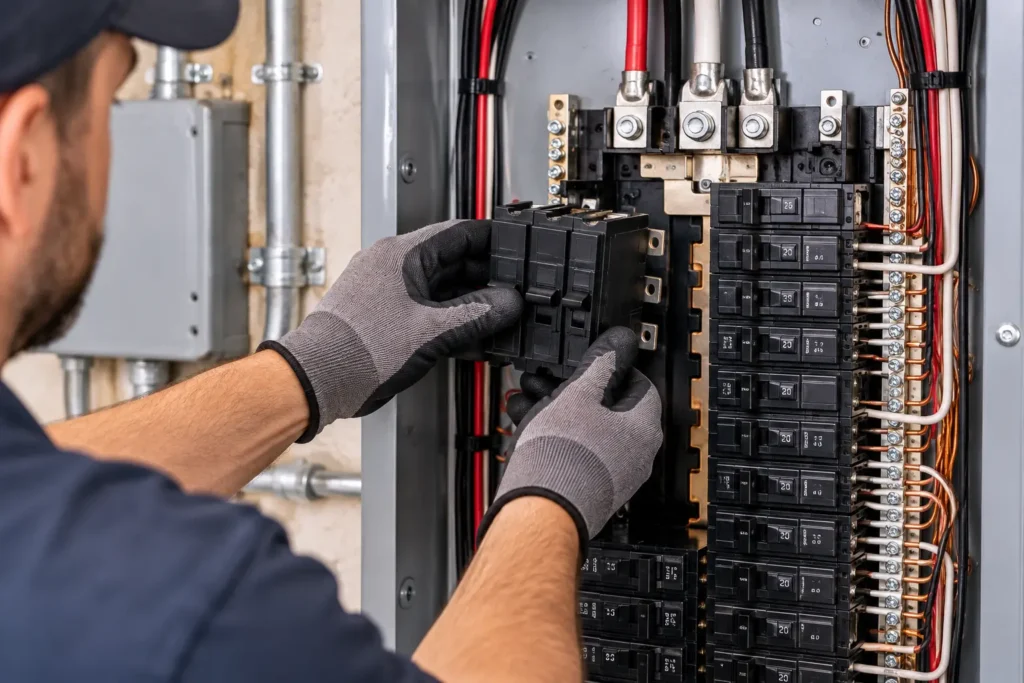
Need circuit breaker replacement Monroe GA homeowners can trust? A circuit breaker that keeps tripping is usually reporting a problem, not causing one. We diagnose the circuit first, then replace the part only if that is genuinely what is wrong.
Replacing it without finding out why removes the warning and leaves the fault in place. Next Gen Electric Co. tests the circuit first, tells you what's actually happening, and replaces the breaker when the breaker is genuinely the failed part, same visit in most cases.
A tripping breaker is the safety system working. In most cases the breaker is fine and something on the circuit isn't.
Resetting once is reasonable. Resetting repeatedly is not. Each trip is a response to a real condition.
Never fit a larger breaker to stop the tripping. The breaker protects the wire, not the appliance.
The trip pattern narrows the cause fast. Trips under load, trips instantly, and trips at random point at three different faults.
Buzzing, warm to the touch, or a burning smell means stop. Leave it off and call, this is the one symptom that shouldn't wait.
Several breakers failing at once usually means the panel, not the breakers.
The five causes
Why does my circuit breaker keep tripping?
Almost every tripping breaker comes down to one of five things. Four of them are the breaker doing exactly what it was designed to do. Only the fifth is a faulty breaker.
Most common
Overloaded circuit
Total draw exceeds the circuit's rating. A kitchen running a kettle, microwave and toaster at once is the classic case. The fix is usually moving a load or adding a dedicated circuit — not replacing anything.
Trips instantly
Short circuit
A hot conductor touching a neutral or a ground somewhere in the run. This needs tracing. A new breaker won't hold either, because the fault is in the wiring or a device, not the breaker.
Wet areas
Ground fault
Current escaping to ground, often through moisture or a failing appliance. A GFCI doing its job. The answer is finding the leak, never defeating the device.
No obvious load
Arc fault
An AFCI detecting the electrical signature of arcing — a damaged conductor, a loose terminal, or in some cases a motor that simply upsets the detection circuitry.
Genuinely faulty
A worn-out breaker
Breakers do age. After decades of thermal cycling one can begin tripping below its rated current, or fail to latch at all. This is the case where replacing the breaker is the actual fix.
Stop — do not reset
Buzzing, warm or scorched
A breaker that hums, feels warm through the cover, or shows discolouration means arcing at the connection. Leave it switched off and call. This one doesn't wait for an appointment window.
Narrowing it down
What the trip pattern tells you
Before you call anyone, notice when it trips. That single observation eliminates most of the possibilities, and it's the first thing we'll ask you on the phone.
When it trips
Most likely cause
What usually fixes it
When several things run at once
Overloaded circuit
Redistribute the load, or add a dedicated circuit
Instantly, every single time
Short circuit
Trace and repair the fault in the wiring or device
Only in a bathroom, kitchen or outdoors
Ground fault
Trace and repair the fault in the wiring or device
If more than one of these describes your situation, or the pattern keeps changing, that's worth a proper look at the panel rather than guesswork.
Safety
Is a tripping breaker dangerous?
The tripping itself isn't the danger - it's the prevention. A breaker interrupting the circuit is the system protecting your wiring from overheating. In that sense a trip is good news.
What is dangerous is the condition behind it, left in place. An overloaded circuit that keeps getting reset is carrying more current than its conductors were sized for, and those conductors run inside your walls where you can't see them heating up.
It's also dangerous to assume a breaker will always save you. A worn breaker that trips below its rating today may
fail to trip at all tomorrow, and obsolete brands like Federal
Pacific and Zinsco have documented histories of exactly that.
Resetting: once, not repeatedly
Flipping a tripped breaker back on once, after unplugging whatever was running, is a reasonable thing to do. If it holds, you found an overload and you've solved it.
If it trips again, stop. Repeated resetting forces current back through a circuit that has already told you twice something is wrong.
Stop and call — don't reset these
A burning or hot-plastic smell near the panel
The breaker or panel cover is warm to the touch
Buzzing, humming or crackling from the panel
Any scorch marks or discolouration
The breaker trips again immediately after resetting
Sparking at an outlet or switch on that circuit
Leave the breaker in the off position and call 678-648-9886. Arcing inside a panel is one of the few electrical
faults that genuinely can't wait.
Before you call
What you can safely check yourself
If none of the stop-signs above apply, there's a simple test that will tell you whether you have an overload — and it costs nothing.
Switch off and unplug everything on the affected circuit - lamps, chargers, appliances, everything.
Go to the panel. Stand to the side of it, turn your face away, and flip the breaker fully to off, then to on.
If it holds, the breaker and the wiring are probably fine.
Plug things back in one at a time, waiting a couple of minutes between each.
Whatever is running when it trips again is either your overload or your faulty appliance.
If it trips with nothing plugged in at all, the fault is in the wiring or the breaker, and that's the point to call someone.
Where the DIY line is, and why
You'll find breakers online for twenty or thirty dollars, and plenty of videos showing the swap. The reason we'd still tell you not to is specific rather than generic.
The bus bars inside a panel stay energised even with the main breaker off. Switching off the main disconnects the branch circuits, it does not de-energise the incoming service conductors or the bus they land on. There is no position of any switch in your house that makes the inside of that enclosure safe to work in.
Beyond the risk, there are two practical problems. Breakers are listed for use in specific panels, and fitting another brand voids that listing and risks a poor connection at the bus, the exact condition that causes overheating. And swapping a breaker without testing the circuit treats the symptom while leaving the fault in the wall.
Everything outside the cover - resetting, unplugging, the isolation test above is yours. Everything inside it isn't.
Cost
How Much Does Circuit Breaker Replacement Cost in Monroe, GA?
This is one of the smaller jobs we do. The price is driven almost entirely by the breaker type and by whether the fault turns out to be the breaker or the circuit behind it.
Nationally, a single breaker replacement including diagnostic time runs $150
to $400. The diagnostic visit alone is typically $75 to $150, and that covers
tracing the fault rather than guessing at it.
Job
What's involved
Typical cost
Standard breaker
Diagnosis plus one thermal-magnetic breaker
$000 – $000
GFCI breaker
Ground-fault breaker, bathrooms and wet locations
$000 – $000
AFCI breaker
Arc-fault breaker, bedrooms and living areas
$000 – $000
Dual-function breaker
Combined AFCI and GFCI protection
$000 – $000
Double-pole (240V)
Dryer, range, HVAC and other 240V circuits
$000 – $000
Circuit fault tracing
Where the fault is in the wiring, not the breaker
Quoted after diagnosis
Why AFCI breakers cost more
People are regularly surprised by this, so it's worth saying plainly: an AFCI or dual-function breaker costs several times what a standard one does. That's manufacturer pricing, not a markup, they contain electronics that a plain thermal-magnetic breaker doesn't.
Current code requires arc-fault protection on a lot of residential circuits. If a code-required replacement is quoted and the number surprises you, this is why.
Obsolete panels change the maths
Breakers for Federal Pacific, Zinsco and Pushmatic panels are scarce and expensive where they're available at all. On
those panels, spending real money on a single breaker often makes less sense than putting it toward a panel change out, we'll
show you both numbers and let you
decide.
Should I just fit a bigger breaker?
No, and this is the single most dangerous shortcut in home electrical work. The breaker is sized to protect the wire behind it, not the appliance in front of it. Fitting a 30-amp breaker on a circuit wired for 20 amps means the conductor can now carry half again its rated current with nothing intervening. That's how wiring overheats inside a wall. If a circuit genuinely needs more capacity, the answer is a new circuit with correctly sized wire.
Sometimes the diagnosis finds something a breaker cannot fix. Damaged wiring
in a circuit typically runs $800 to $2,500 to replace, and a full panel
replacement $2,000 to $4,000. We tell you which one you are looking at before
any work starts, not halfway through.
Swapping a breaker takes ten minutes and sometimes fixes nothing. Here's what happens on a call before any part comes out of the van.
01
Load check
What's actually on the circuit and what it draws under real conditions, not what the nameplates claim.
02
Continuity & insulation
Testing the run for shorts, ground faults and damaged insulation between the panel and the last outlet.
03
Connection inspection
Terminals, the breaker's grip on the bus bar, and any heat discolouration at the lugs.
04
The answer
We tell you which it is — the breaker, the circuit, an appliance or the panel — and quote only what's actually needed.
Worth knowing
Is there a tax credit for a panel upgrade?
Most breaker calls end with a breaker. Some don't, and it's better to hear why before the visit than after.
If several breakers are failing across the panel, the common factor usually isn't the breakers,
it's the bus bar they all land on. Corroded or damaged bus stock can't be repaired in place, and that makes it a panel change out.
If the main breaker is the one tripping, no branch breaker is at fault at all. That's total
household demand exceeding what the service can deliver, and the fix is a service upgrade.
And if the panel is an obsolete brand where breakers are hard to source, the economics stop favouring repair fairly quickly.
We'll always quote the smaller job when the smaller job is the right one. We'll also tell you plainly when it isn't.
If you're replacing the panel anyway
Standard
Thermal-magnetic
The ordinary breaker protecting against overload and short circuit. Still correct for most general-purpose circuits.
GFCI
Ground-fault
Required for bathrooms, kitchens, garages, outdoors and anywhere near water.
AFCI
Arc-fault
Required in bedrooms and living areas under current code. Detects the arcing signature of damaged wiring.
Dual function
AFCI/GFCI combo
Both protections in one device, increasingly required in kitchens and laundry areas.
Every breaker we fit is listed for your panel. We don't mix brands, and if the correct breaker is no longer manufactured we'll say so rather than improvise.
FAQ
Breaker replacement questions
Why does my circuit breaker keep tripping?
Most often the circuit is overloaded, total draw exceeds its rating. The next most common causes are a short circuit, a ground fault, an arc fault, or a breaker that has worn out and now trips below its rated current. The pattern tells you a lot: tripping when several appliances run points at overload, while tripping instantly every time points at a short circuit. Repeated resetting isn't a fix, because the breaker is reporting a condition that's still there.
Is it safe to keep resetting a tripping breaker?
Resetting once, after unplugging whatever was running, is reasonable. Resetting repeatedly is not. Each trip is the safety system responding to a real condition, and forcing the circuit back on can overheat conductors inside your walls. If a breaker buzzes, feels warm, or shows any scorching, leave it off and call rather than resetting it at all.
Can I replace a circuit breaker myself?
We'd advise against it. The bus bars inside the panel remain energised even with the main breaker off, so there's no safe de-energised state for a homeowner working inside the enclosure. Beyond the risk, replacing a breaker without diagnosing the circuit usually treats the symptom rather than the fault, and breakers must be listed for the specific panel they go into.
How Much Does Circuit Breaker Replacement Cost in Monroe, GA?
It depends mainly on the breaker type and the panel brand. Standard thermal-magnetic breakers are inexpensive; AFCI and dual-function breakers cost several times more because of the electronics inside them. Breakers for obsolete panels like Federal Pacific or Zinsco are scarce and expensive where available. We diagnose first and quote in writing, so you know whether you're buying a breaker or a repair.
What does it mean if the breaker won't reset at all?
A breaker that won't latch usually means one of two things: there's still a fault on the circuit holding it open, or the breaker itself has failed mechanically. It can also mean the breaker isn't seated properly on the bus bar. Testing distinguishes them quickly, but a breaker that feels loose or crunchy when you move the handle is generally at the end of its life.
Why does my GFCI or AFCI breaker keep tripping?
These are more sensitive by design, so they catch things a standard breaker wouldn't. A GFCI tripping usually means current is leaking to ground, moisture in an outdoor outlet or a failing appliance are the common culprits. An AFCI tripping can mean genuine arcing from a damaged conductor or a loose terminal, but some motors and older appliances also produce electrical noise that trips them. Either way it's worth finding the cause rather than swapping in a standard breaker, which would remove the protection entirely.
Should I install a bigger breaker to stop the tripping?
No. The breaker is sized to protect the wire behind it. Fitting a larger one means the conductor can carry more current than it's rated for without anything intervening, which is how wiring overheats inside walls. If a circuit genuinely needs more capacity, the answer is a new circuit with correctly sized wire, not a bigger breaker on the old one.
Can I use a different brand of breaker in my panel?
No. Breakers are listed for use in specific panels, and mixing brands voids that listing. It also risks a poor connection at the bus bar, exactly the condition that causes overheating. We fit breakers matched to your panel, and if the right breaker is no longer manufactured we'll tell you rather than improvise.
How long does breaker replacement take?
A straightforward diagnosis and replacement is usually one to two hours. Tracing an intermittent fault along a circuit takes longer, and we'll tell you if that's where it's heading rather than running the clock silently.
Do you replace breakers in commercial panels?
Yes. We handle breaker replacement and circuit diagnosis in commercial and three-phase panels across Walton and Oconee County, and can schedule outside trading hours where a circuit outage would disrupt business.
Reviews
Breaker calls around Walton County
Replace with real Google reviews before launch.
John Smith2 months ago
Kitchen breaker kept tripping. Turned out to be a failing appliance, not the breaker at all. They found it in an hour and didn't sell us parts we didn't need.
William Jones3 months ago
Breaker was buzzing and warm. They came out same day, found arcing at the lug and sorted it properly. Explained why we shouldn't have kept resetting it.
Thomas Davis5 months ago
Honest about the fact that three failing breakers meant the panel was the real issue. Quoted both options and let us decide instead of pushing the bigger job.