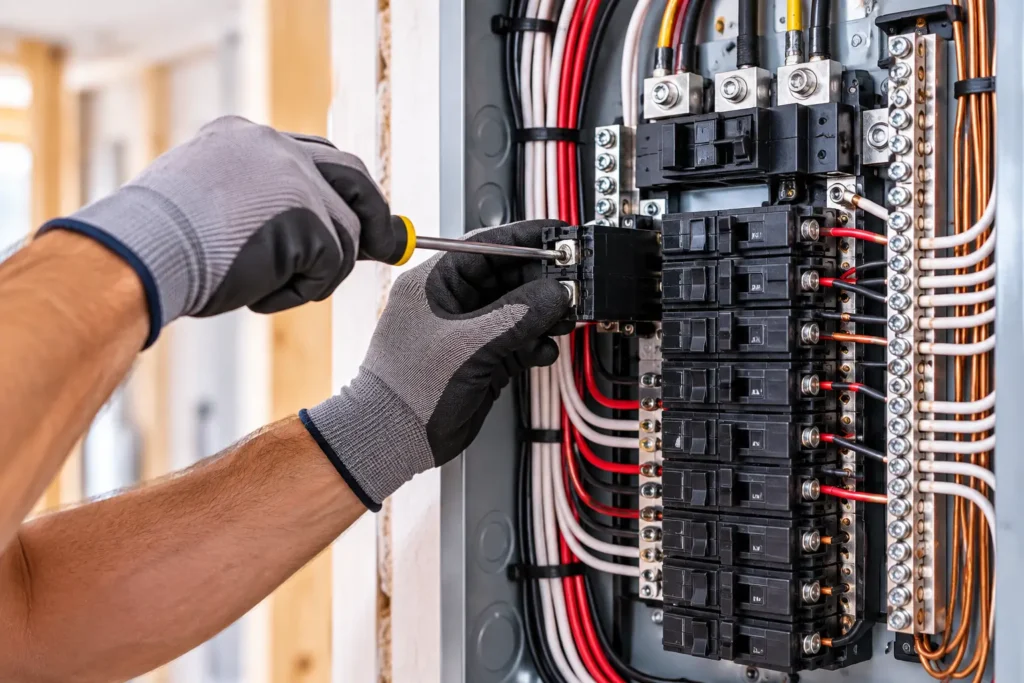
Looking for circuit installation Monroe GA homeowners can rely on? A dedicated circuit is a run of wire from your panel that serves one appliance and nothing else, required for anything that draws heavily and continuously.
Next Gen Electric Co. adds circuits and outlets across Monroe for hot tubs, ranges, dryers, workshops, home offices and EV charging. We check your panel has room before quoting, and we'll tell you when an existing circuit will do the job perfectly well.
Book everything at once. A single-outlet call gets billed near the minimum charge, so one outlet often costs nearly as much as three.
Distance from the panel is the main cost driver. New wire runs commonly price around $7 to $10 per linear foot.
Not everything needs its own circuit. We'll tell you when adding to an existing one is safe and code-compliant.
The parts are cheap; the labour isn't. A receptacle is a few dollars. Labour is typically 70 to 90 percent of the bill.
A dedicated circuit runs $250 to $900 nationally, with most people paying around $650.
A full panel blocks new circuits entirely. If there's no slot, that's a separate conversation before anything else.
Cost
How much does circuit installation Monroe GA cost?
This is one of the more predictable jobs we quote, because the variables are simple: how far it is from the panel, whether it needs its own circuit, and how easy the route is.C
Job
What's included
Typical range
Dedicated 20A circuit
New run from the panel, breaker, outlet
$0,000 – $0,000
Dedicated 240V circuit
30–50A run, double-pole breaker, receptacle
$0,000 – $0,000
New 120V outlet
Added to an existing nearby circuit
$0,000 – $0,000
Replacing an outlet
Swap only, existing wiring sound
$0,000 – $0,000
GFCI outlet
Replacement, or new in a wet location
$0,000 – $0,000
Outdoor outlet
Weatherproof in-use cover, GFCI protected
$0,000 – $0,000
3-prong to 4-prong dryer
Usually needs a new run to the panel
$0,000 – $0,000
Long runs
Priced by distance where the route is straightforward
$0,000 – $0,000
Why labor is 70 to 90 percent of it
People are often surprised by an outlet quote, and it's worth explaining why rather than letting it sit there.
A standard receptacle is a few dollars. A GFCI is fifteen to fifty. Even a
heavy NEMA 14-50 for an EV charger is under thirty. The breaker and wire are
the only materials that add up, and only on longer runs.
The parts are almost free. A standard receptacle is a few dollars. A GFCI is fifteen to fifty. Even a heavy NEMA 14-50 for an EV charger is under thirty. The breaker and the wire are the only materials that add up, and only on longer runs.
What you're paying for is the route getting a conductor from your panel to a specific point in a specific wall, through joists, insulation, fire blocking and finished surfaces, without leaving damage behind. That's the skilled part, and it's what takes the time.
What actually moves the number
Distance from the panel. Every foot is wire and labour.
Route difficulty. An unfinished basement or open attic is quick. A finished two-storey wall is not.
Amperage. A 50A circuit needs much heavier conductor than a 20A one.
Panel space. No free slot means the job starts somewhere else entirely.
Code requirements. GFCI or AFCI protection where the location calls for it.
Worth knowing before you call
Save money: book them all at once
The cheapest way to handle circuit installation Monroe GA homeowners need is to book everything at once.
A single-outlet visit gets billed close to the minimum charge. Getting a licensed electrician to your door anywhere in Monroe involves a van, tools, travel and a first hour that's chargeable whether it takes ten minutes or sixty.
The practical consequence: one outlet often costs nearly as much as three. Once we're on site with the panel open and the tools out, each additional item is mostly just the time it takes.
Make a list before you call
Walk your Monroe home once and write down everything. Not just the thing that prompted the call, all of it:
The outlet you've been running an extension lead to for two years
The one behind the sofa that doesn't work
The bathroom outlet with no GFCI protection
The garage that has one outlet for the whole space
The outdoor outlet you keep meaning to add
The three-prong outlets on two-wire circuits with no real ground
Batching several outlets and circuits into one visit typically saves around
30 percent compared with booking them separately. Booking in autumn or
winter usually means faster scheduling too, since spring and summer are when
everyone calls at once.
Send us the list when you book. We'll quote the lot, and the total will be considerably less than doing them one at a time over three years.
The same applies to bundling with other work. If a panel change out, an
EV charger or a lighting
job is already planned, adding circuits to that visit is the cheapest they'll ever be.
Adding to an existing circuit vs a new run
Tap existing wiring
New dedicated circuit
Typical time
Under an hour
2–4 hours
Needs a panel slot
No
Yes
Relative cost
Much lower
Higher
Suits
Lamps, TVs, general use
Heavy or continuous loads
Adds capacity
No — shares it
Yes
Distance limit
Best within 6–10 ft
Any, priced by run
If there's sound wiring within a few feet of where you want the outlet, tapping it is usually the right answer — and we'll say so rather than quoting a run from the panel.
The rule
What needs dedicated circuit installation Monroe GA homes rely on?
Anything that draws heavily, runs continuously, or would take the whole room down if it tripped. Code requires dedicated circuits for a specific list — and beyond that list, it's a judgement call we're happy to talk through.
The last column is optional, not required. A home office doesn't need its own circuit by code — but if a space heater and a laser printer keep tripping the bedroom circuit next door, that's what a dedicated run solves. We'll tell you which items on your list are code requirements and which are simply sensible.
Why people call
Common reasons Monroe homes need a new circuit
Most of these come from the same underlying cause: a house built for how people lived in 1985, running the loads of 2026.
A circuit that keeps tripping
The correct fix for a chronically overloaded circuit is a new dedicated run — never a bigger breaker on the old
wire.
A garage or workshop
One outlet for a whole garage is common in older Monroe homes. Bench tools and a compressor need considerably more.
A hot tub or pool
Always a dedicated 240V circuit with GFCI protection, plus a disconnect within reach of the tub. Not a job to improvise.
A home office
A desk that trips the bedroom circuit when the heater comes on is a load problem, not a bad breaker.
A kitchen remodel
Modern kitchens need multiple small-appliance circuits plus dedicated runs for the dishwasher, disposal and microwave.
Extension leads everywhere
If a room is running on power strips daisy-chained across the floor, it needs outlets — that's a fire risk, not a decor problem.
Check this first
Do I have room in my panel?
Where the panel is rated for them, a tandem breaker typically adds $25 to
$80. Where it is not, a panel upgrade runs $1,500 to $4,000, which is a
different conversation entirely.panel is rated to accept them. If it is not, a panel upgrade runs $1,500 to
$4,000, which is a different conversation entirely.
Every new dedicated circuit needs a free slot in your panel the first thing we check on a Monroe call. It's the first thing we look at, and occasionally it changes the whole conversation.
If there's a spare slot, you're fine. The circuit goes in and the job is exactly what you expected.
If the panel is full, there are a few possibilities. Sometimes a tandem breaker can free up space,
if the panel is rated to accept them many aren't, and fitting them where they're not permitted is a common thing we
find during inspections.
Sometimes a panel change
out is the answer. And sometimes a subpanel is the
cheaper route.
When a subpanel makes sense
If you're adding several circuits in one area a garage, a workshop, a finished basement, a detached building, a subpanel fed from the main panel uses one slot and gives you a dozen. It's usually cheaper than replacing the main panel, and it puts the breakers where the work is.
What a subpanel can't do is add capacity. If your service is
already at its limit, moving breakers around doesn't create more power, it just relocates the problem.
Can an EV charger share my dryer circuit?
Sometimes, and it can save the cost of a new circuit entirely. If a 240V
dryer outlet already sits near where you park, a load-sharing device can
split that existing circuit between the dryer and a charger, since the two
rarely run at the same time. It only works where the circuit and panel
support it, so we check before recommending it rather than after.
GFCI, AFCI and where code requires them
Two kinds of protection come up constantly on new Monroe circuits, and both add to the cost so it's worth knowing why they're on the quote.
GFCI protects against current leaking to ground, which is what hurts people. Code requires it in bathrooms, kitchens, garages, unfinished basements, laundry areas, outdoors, and anywhere near water.
AFCI detects the electrical signature of arcing, a damaged conductor or a loose terminal that could start a fire. Current code requires it across most habitable rooms.
Where it can be done at the breaker instead
Protection can often be provided at the breaker rather than at each outlet, which sometimes works out cheaper and sometimes doesn't depending on how many devices are on the circuit. We'll work out which way round is better for your particular run rather than defaulting to one.
Outside the house
Outdoor and detached building circuits
Anything leaving a Monroe house changes the requirements, and it's where DIY work most often goes wrong.
Outdoor outlets
Every outdoor receptacle needs GFCI protection and a weatherproof in-use cover the kind that stays sealed with a lead plugged in, not the flip-up type that only protects an empty outlet. It's a small detail that fails inspections regularly.
Detached garages, barns and workshops
Common across Walton and Oconee County, and a bigger job than people expect. A feeder to a detached building generally means trenching at the correct depth, direct-burial or conduit-rated cable, a disconnecting means at the building, and its own grounding electrode.
It's the trenching that moves the price, which is why we won't quote a detached building over the phone the distance and what's between the two points decide the number.
Well and septic pumps
Out toward Good Hope and Lake Oconee these are on their own dedicated circuits, and they matter more than most: when that circuit is down, there's no water. Worth knowing where its breaker is before you need to.
Permits
Do I need a permit in Walton County?
For a new circuit, generally yes. Adding a circuit means new wiring and a new breaker in the panel, and that's permitted work. Replacing an existing outlet on sound wiring generally isn't.
We'll tell you which side your job falls on at the site visit. Where a permit is needed we pull it in our name, schedule the inspection and meet the inspector.
Why it matters on small jobs too
It's tempting to think a permit is overkill for one circuit. The trouble is that unpermitted work is cumulative a buyer's inspector doesn't find "one circuit", they find a house with undocumented electrical work and start asking about all of it.
The hot tub circuit is the one that catches people most often. It's a 240V run, usually outdoors, usually added by whoever delivered the tub, and it turns up at every sale.
What the inspection checks
Conductor size matches the breaker
GFCI and AFCI protection where required
Boxes accessible and properly secured
Connections torqued and terminated correctly
Panel directory updated to show the new circuit
Never fit a bigger breaker to stop a circuit tripping
If a circuit keeps tripping, the answer is a new circuit with correctly sized wire — not a larger breaker on the existing one. The breaker is sized to protect the conductor behind it, so fitting a bigger one lets that wire carry more current than it's rated for with nothing intervening. That's how wiring overheats inside a wall. It's the most dangerous shortcut in home electrical work and it's genuinely common.
How much does circuit installation Monroe GA cost?
Nationally, a dedicated circuit runs $250 to $900 installed with most people paying around $650. A 240V circuit for a dryer, range or hot tub typically falls between $250 and $800, averaging near $450. The main variables are the distance from the panel, how difficult the route is, and the amperage — new wire runs commonly price around $7 to $10 per linear foot. We quote in writing after seeing the route.
Why does one outlet cost almost as much as three?
Because a single-outlet visit gets billed close to the minimum charge. Getting a licensed electrician to your door involves travel, a van and a chargeable first hour whether the work takes ten minutes or sixty. Once we're on site with the panel open, each additional item is mostly just the time it takes. Make a list of everything before you call — it's genuinely cheaper.
Do I need a dedicated circuit or can I add to an existing one?
It depends on the load and the location. Code requires dedicated circuits for large appliances, kitchen small-appliance circuits, bathrooms, hot tubs, EV chargers and most fixed equipment. For general-purpose outlets — a lamp, a TV, a phone charger — adding to a nearby existing circuit is usually fine and considerably cheaper. We'll tell you which applies rather than defaulting to the bigger job.
What if my panel is full?
A few options. Some panels accept tandem breakers, which frees up space — but many don't, and fitting them where they aren't permitted is something we find regularly during inspections. A subpanel uses one slot and gives you a dozen, which suits garages, workshops and basements. A panel change out is the permanent answer. What none of them do is add capacity — if the service itself is maxed out, that's a service upgrade conversation.
How much does a 240V outlet cost to install?
Nationally $250 to $800, averaging around $450, though a simple installation on the other side of the panel wall can be less. The amperage matters: a 50A circuit for an EV charger needs much heavier conductor than a 30A dryer circuit. Distance and route difficulty drive the rest.
Can you change my 3-prong dryer outlet to a 4-prong?
Yes. Older dryer circuits used three conductors with no separate ground; current code requires four. In most cases this means running a new cable back to the panel rather than simply swapping the receptacle, which is why it costs more than it sounds like it should — typically $150 to $500 depending on the run.
Do I need a permit to add a circuit in Walton County?
Generally yes for a new circuit, since it involves new wiring and a new breaker. Replacing an existing outlet on sound wiring generally doesn't. We'll tell you which applies at the site visit and pull the permit where one is needed. The hot tub circuit is the one that most often turns up unpermitted during a sale.
Why does my quote include GFCI or AFCI protection?
Because code requires it for the location. GFCI protects against current leaking to ground and is required in bathrooms, kitchens, garages, basements, laundry areas and outdoors. AFCI detects arcing and is required across most habitable rooms. Some locations need both. These devices cost several times what a standard breaker or receptacle does — that's the device price, not a markup.
Can you run power to a detached garage or workshop?
Yes, and it's common around Walton and Oconee County. A feeder to a detached building generally needs trenching at the correct depth, suitable cable, a disconnecting means at the building and its own grounding electrode. The trenching is what moves the price, so we'll always look at the route rather than quoting over the phone.
Is there a difference between a 220V and 240V outlet?
No. 220V, 240V and 250V outlets are the same thing, named differently
over the years. A 220V appliance plugs into a 240V outlet without any
problem. What matters is the amperage and plug configuration, which has
to match the appliance.
Reviews
Circuit work around Walton County
Replace with real Google reviews before launch.
Placeholder Name2 months ago
Told us to make a list of everything rather than just doing the one outlet we called about. Ended up with six things done for barely more than the original quote.
Placeholder Name2 months ago
Hot tub circuit done properly with the disconnect and GFCI, and they pulled the permit. The company that delivered the tub had offered to just wire it in.
Placeholder Name2 months ago
Panel was full so they fitted a subpanel in the workshop instead of replacing the main. Cheaper, and now the breakers are where I actually use them.