
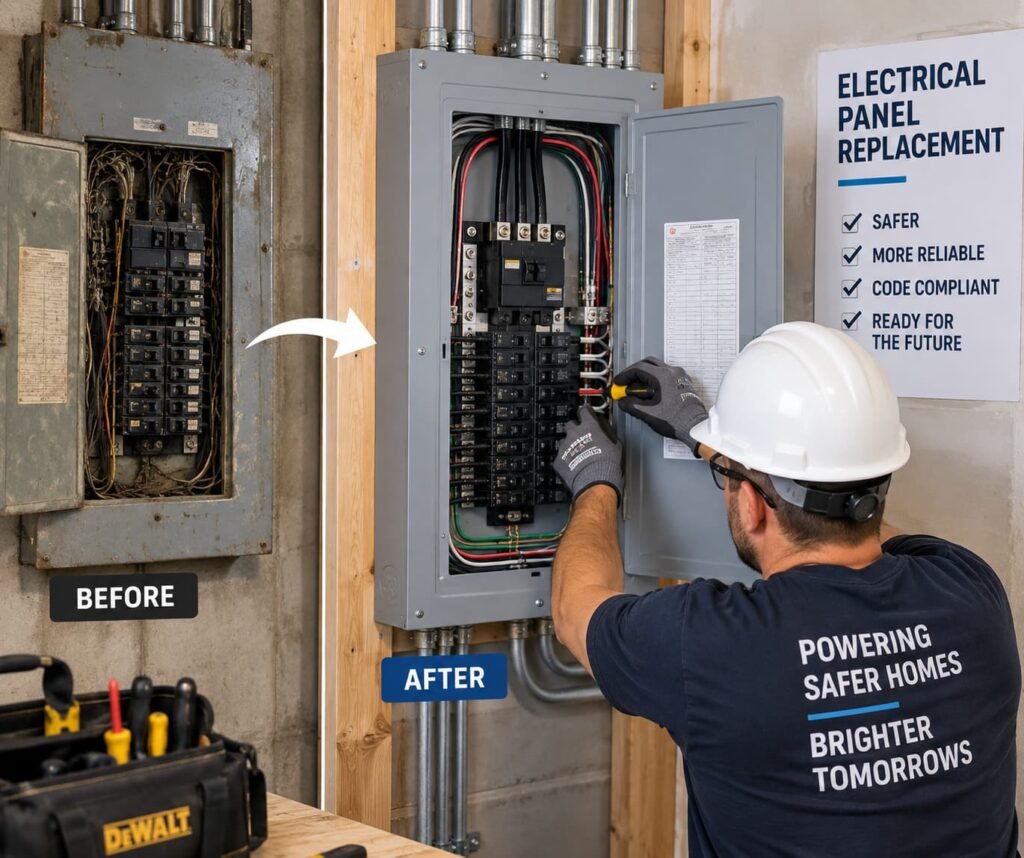
A panel change out replaces the breaker box itself - the enclosure, bus bars and breakers - while keeping your existing service amperage.
Looking for electrical panel replacement Monroe GA homeowners can trust? A panel change out replaces the breaker box itself the enclosure, bus bars and breakers while keeping your existing service amperage.
What a typical Monroe job looks like.
Cost
Most Monroe electricians won't publish a number. We will. What follows is the typical range for panel work in Monroe and Walton County, broken out by job type so you can see which one actually applies to your house.
Standard like-for-like replacement, same amperage
Fuse box to modern breaker panel, often needs rewiring
Secondary panel for a garage, basement or addition
Moving the panel to a better or code-compliant location
One failed breaker, not a panel job at all
Where code requires arc-fault or ground-fault protection
Breaker type, Circuit count, Grounding condition, Panel location, Existing wiring, Permit fees
A new panel and breakers, every circuit re-landed and labeled, grounding and bonding brought up to code, the permit, the inspection, and the site left clean. If we open the panel and find something that genuinely changes the scope, we stop and talk to you before continuing.
When you need one
A panel is a wear item. Bus bars corrode, breakers lose their calibration over decades, and enclosures fill up. These are the symptoms Monroe homeowners call us about most often.
No space left for a new circuit, or tandem breakers doubled up in a panel that isn't rated to accept them.
Federal Pacific Stab-Lok, Zinsco, Challenger or Pushmatic. Insurers and buyers' inspectors flag all four.
Discolouration, melted insulation or a cover that's warm to the touch means arcing inside. Call before you touch anything.
A breaker that trips instantly, buzzes, or feels loose in its slot is often a bus bar problem rather than a breaker problem.
A fuse box means the electrical system predates modern safety standards entirely. This is nearly always a replacement.
A flagged panel stalls closings. Replacing it with a documented permit gives you a clean answer for the file.
Known problem panels
These four turn up regularly in Monroe homes built between the 1950s and the 1990s. If your panel carries one of these names it's worth having looked at — many insurers ask about them directly, and some decline to write policies on them.
Widely reported failures of breakers to trip under fault conditions. The single most commonly flagged panel in home inspections.
Bus bars that corrode and breakers that can weld to them, so the breaker no longer disconnects when it should.
Overheating at the breaker connections, and a shortage of safe replacement parts still in production.
No visible trip indication, stiff mechanisms, and replacement breakers that are scarce and expensive where available at all.
Electrical fires remain a significant cause of residential fire loss in the United States, and aging panels and wiring are a recurring factor. The Electrical Safety Foundation International and the U.S. Fire Administration both publish data worth reading if you're weighing this up. If your Monroe home is thirty years old or more and the panel has never been assessed, an inspection is overdue rather than optional.
Making the call
Not every panel problem needs a new panel. The right answer depends on the panel's age, its brand, and whether the fault is isolated or systemic.
Not every panel problem needs a new panel. If the fault is isolated and the enclosure, bus bars and grounding are sound, a repair costs a fraction of a replacement and we will say so.
An obsolete brand such as Federal Pacific, Zinsco, Challenger or Pushmatic Scorch marks, corrosion or an enclosure warm to the touch Every slot full with no room left to expand Grounding that needs correcting anyway Replacement breakers no longer in production for that brand.
The one thing worth saying plainly: if a single circuit keeps tripping and the rest of the house is fine, that is almost certainly a breaker or circuit problem, not a panel problem. We diagnose before we quote, so nobody gets sold a panel on the strength of one bad breaker.
Scope of work
A proper panel replacement is more than swapping the box. The grounding, the labelling and the permit are where cheap quotes cut corners — and they're the parts an inspector looks at first.
01
A modern enclosure with spare capacity, fitted with new breakers rated and listed for that panel — no mixed brands.
02
Every existing circuit transferred, torqued to specification and tested under load before the cover goes back on.
03
Ground rods, water-pipe bond and neutral-ground separation brought up to current National Electrical Code requirements.
04
Arc-fault and ground-fault protection fitted on the circuits code requires it on, and explained on the quote rather than sprung on you.
05
Walton County permit pulled in our name. We meet the inspector on site and close the permit out properly.
06
A legible panel directory filled in, the site cleaned, and the new panel explained to you before we leave.
Timeline
Most residential panel change outs in Monroe are a single-day job, with power off for roughly four to six hours. Panels with a high circuit count, or an interior panel that needs drywall work around it, can run longer.
Unlike a service upgrade, a like-for-like panel replacement usually doesn't require the utility to disconnect the meter, which is why the overall project moves faster. The permit still has to be issued and the inspection scheduled, so allow a week or two around the work itself.
Do I need a permit in Walton County?
Yes. Panel replacement requires an electrical permit and a county inspection. We pull it in our name, schedule the inspection and meet the inspector on site.
Keep the closed permit somewhere safe. Buyers' inspectors ask for it, insurers ask for it, and an unpermitted panel discovered mid-sale costs far more to resolve than the permit ever did.
Rule of thumb: out of slots means a panel change out. Out of capacity means a service upgrade.
Sometimes, and it's usually cheaper. If your main panel is in good condition and the service has capacity but you've simply run out of physical space, a subpanel adds slots without replacing the main. It's a common answer for detached garages, workshops, finished basements and additions around Monroe. What a subpanel can't do is add capacity, if the service itself is maxed out, it just moves the problem.
How it runs
Step 01
We look at the meter, panel, grounding and how the drop enters the house. No guessing over the phone.
Step 02
A fixed written price covering the panel, breakers, grounding, permit and inspection. Nothing starts until you approve a number.
Step 03
We file with Walton County and schedule the inspection around your install day.
Step 04
Power off four to six hours. New panel fitted, every circuit re-landed, torqued and labeled, grounding corrected and tested.
Step 05
The county inspector signs off, the utility reconnects, and we hand over the paperwork and walk you through it.
Worth knowing
There can be. The federal Energy Efficient Home Improvement Credit (IRC Section 25C) offers a credit of 30% of the cost, capped at $600, for a qualifying electrical panel upgrade — currently available through the end of 2032.
The conditions matter, and this is where people get caught out. A standalone panel replacement done as general maintenance does not qualify on its own.
We're electricians, not tax advisors. Check the current rules on the IRS page for this credit and speak to your accountant before counting on it. What we can do is make sure the installation itself meets the technical requirements, and give you an itemised invoice you can hand to whoever files your return.
Cheapest moment to fit a whole-home surge protector, since the panel is already open and de-energized.
The new panel's spare slots make added circuits straightforward. Running them now costs less than a second visit later.
If an EV charger is on the horizon, sizing the panel for it now avoids paying twice.
Before you hire anyone
Panel quotes vary far more than they should, usually because they're not quoting the same scope. Ask these six questions of everyone you get a price from — including us.
A quote excluding the permit isn't comparable to one that includes it. Get every quote on the same basis before you compare.
These cost several times more than standard breakers. A quote that quietly leaves them out will grow later.
Older Monroe homes often have incomplete grounding. If nobody mentions it, nobody has checked it.
If they haven't diagnosed the circuit, they can't answer this. A good electrician will happily talk you out of the bigger job.
They should give you a specific window. If they can't, they haven't planned the day.
An estimate can move. A fixed written price can't, unless the scope genuinely changes and you approve it first.
FAQ
The price depends on the panel size, whether the panel is inside or outside, how many circuits have to be re-landed, the condition of the existing grounding, whether AFCI or GFCI breakers are required, and Walton County permit fees. AFCI breakers in particular cost considerably more than standard ones and can shift the total. Nationally, a standard like-for-like panel replacement typically falls between $1,000 and $3,000, with fuse-box conversions and relocations running higher. We give you a fixed written price after opening the panel and seeing what's actually in there.
That's a different job. Increasing amperage means replacing the service entrance cable and meter base as well as the panel, with utility coordination, so that's a service upgrade, and it costs more than a panel change out. If your existing 100-amp service still covers the house comfortably and only the panel is the problem, you don't need the bigger job.
Most residential panel change outs are a single-day job, with power off for roughly four to six hours. Panels with a high circuit count, or an interior panel that needs drywall work around it, can run longer. The permit and inspection add a week or two around the work itself.
In most cases, yes. If the existing branch wiring is in sound condition it stays exactly where it is and simply gets re-landed in the new panel. Rewiring only becomes part of the conversation if we find knob-and-tube, damaged insulation, or aluminium branch wiring that needs pigtailing. We assess the wiring during the site visit and tell you before quoting rather than discovering it on install day.
Yes. A panel replacement requires a permit and a county inspection. We pull it in our name, schedule the inspection and meet the inspector on site. Keep the closed permit — buyers' inspectors and insurers both ask for it, and an unpermitted panel found mid-sale is expensive to resolve.
There's no law requiring it, but there are strong practical reasons. Both brands have well-documented failure modes where the breaker doesn't disconnect under fault conditions, which is the one thing a breaker exists to do. Home inspectors flag them, some insurers ask about them or decline cover, and replacement breakers are hard to source. Most Monroe homeowners we speak to replace them either before selling or after an insurer raises it.
Sometimes, and it's usually cheaper. If the main panel is in good condition and the service has capacity but you've run out of physical space, a subpanel adds slots — common for detached garages, workshops and finished basements. What it can't do is add capacity. If the service itself is maxed out, a subpanel just moves the problem somewhere else.
Generally no, not for age or normal wear. Insurance may cover damage caused by a specific covered event such as a lightning strike or fire, but replacing a panel because it's old, full or an obsolete brand is an out-of-pocket expense. Ironically, some insurers will require the replacement as a condition of writing or renewing the policy — check your own policy wording rather than assuming either way.
If your panel is over 25 years old, an obsolete brand, or full, then yes — it removes a real safety risk and a genuine obstacle at sale time. If it's a modern panel under 25 years old with spare slots and one faulty breaker, it isn't worth it and we'll tell you so. The honest answer depends on your panel, not on a general rule.
Yes. We handle commercial panel replacements and subpanel work across Walton and Oconee County, including three-phase panels for shops and production facilities, scheduled outside business hours where the outage would disrupt trading.
Related services
100A → 200A
When the issue is capacity rather than the box itself — the bigger version of this job.
Breakers
When one circuit is the problem and the panel is otherwise sound.
Inspection
A written, photographed report — often what prompts a panel replacement in the first place.
SPD
Cheapest to add while the panel is already open and de-energised.
Circuits
The new panel's spare slots are what make added circuits possible afterwards.
Standby
Transfer switch work pairs naturally with a new panel.
Ready when you are
A site visit, an honest answer on whether it's the panel, one breaker or the whole service, and a fixed written price covering the permit and inspection.